 Our pick
Vis and Blue Cave
From Hvar harbour
- Duration
- 7.5 hrs
- Group
- Up to 12
- Rating
- 4.84
- Price
- from $137
Guides
Language
EnglishCurrency
US dollar · $GetYourGuide shows prices in the currency you choose.
Guide · The cave
A small sea cave on a near-empty islet west of Vis, lit from below by sunlight bouncing off sand. Here is where it is, how it works and what a visit is like.
Editorial team, blue-cave-hvar.comUpdated October 25, 20267-minute read42 sources
Quick answer
Many people search for the cave together with Hvar, because Hvar town is where most of them sleep and where the speedboats leave. The cave itself is not on Hvar at all. It sits in the cove of Balun on Biševo, a small island 4.5 nautical miles (8.3 km) off the fishing town of Komiža.1 Biševo lies 5 km south-west of Vis, across the Biševo Channel, and belongs to the Town of Komiža.2 From Hvar you cross open water past the Pakleni islands and along the coast of Vis before you reach it.
Biševo is a quiet place once the boats have gone. Its highest point, Stražbenica, rises 239 metres above the sea at the south-east end of the island.8 The island had 115 inhabitants in 1961 and only 15 by 2011.9 That emptiness is part of the charm: the cave is the only crowded corner of an island that otherwise feels almost abandoned.
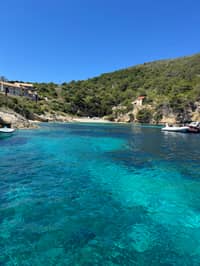
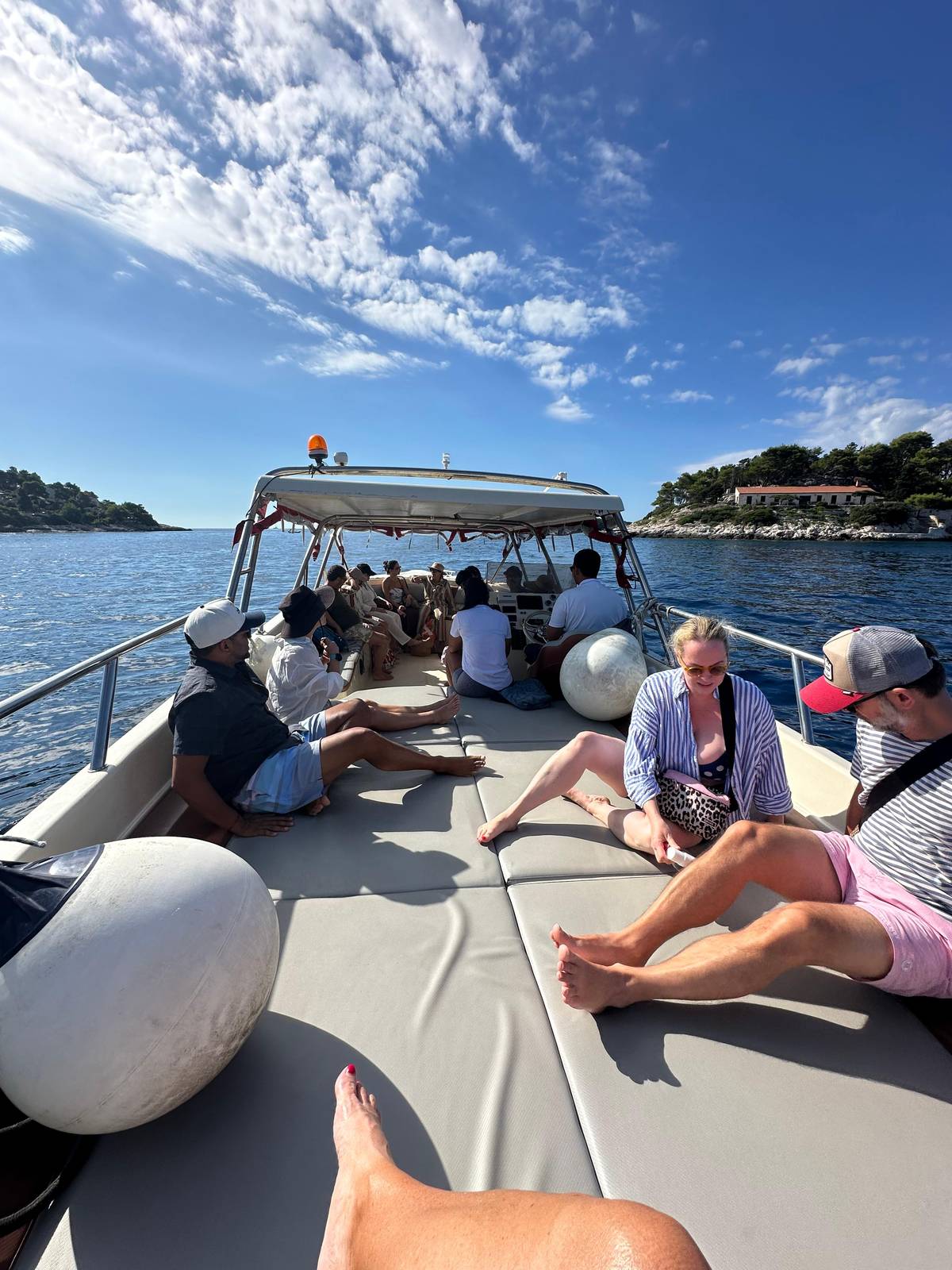
For planning, think of the day as a trip to Vis with the cave as its highlight. The speedboat from Hvar on this site is a 7.5-hour day with a small group of up to 12 people. Its listing names the Green Cave on Ravnik, Stiniva, the Blue Cave on Biševo and a swim at Budikovac or Pritišćina before a lunch stop. So you see the cave as one stop among several, which is how almost every boat from Hvar or Split handles it.
History
1050
Benedictines from the Tremiti islands found a monastery on the island.10
Before 1884
Local fishermen know the cave long before visitors do.11
1884
The painter introduces the cave to the world and the entrance is blasted open.1213
1951
The cave becomes a geomorphological monument of nature.14
2019
A survey counts 119 marine species inside, five strictly protected.15
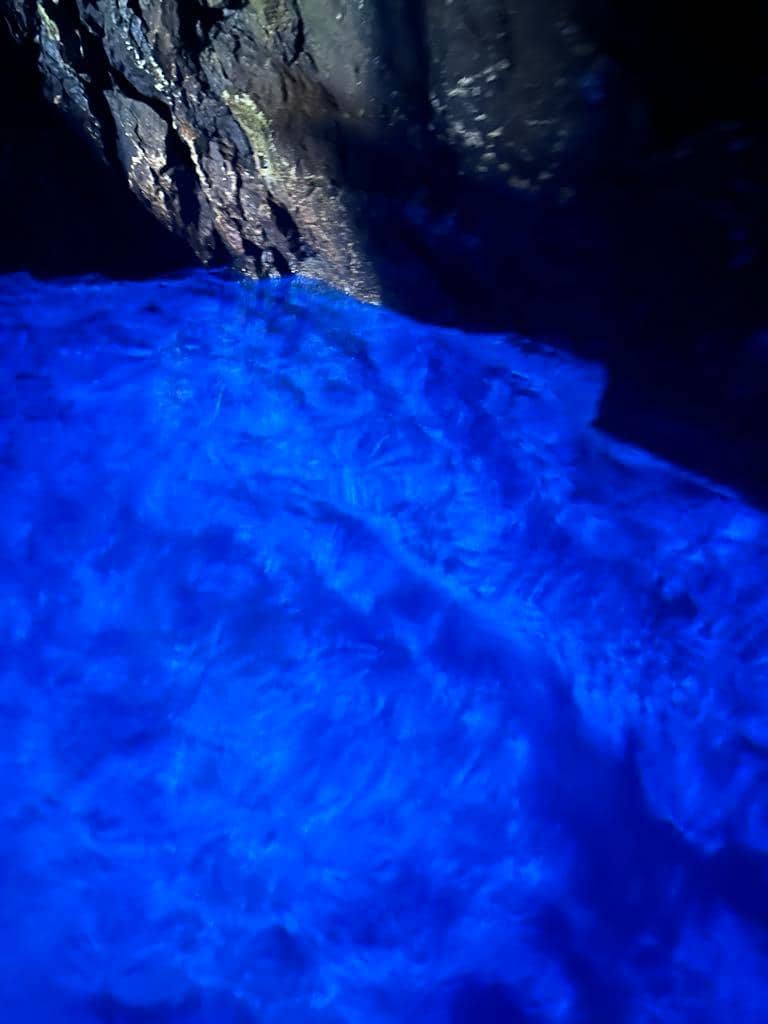
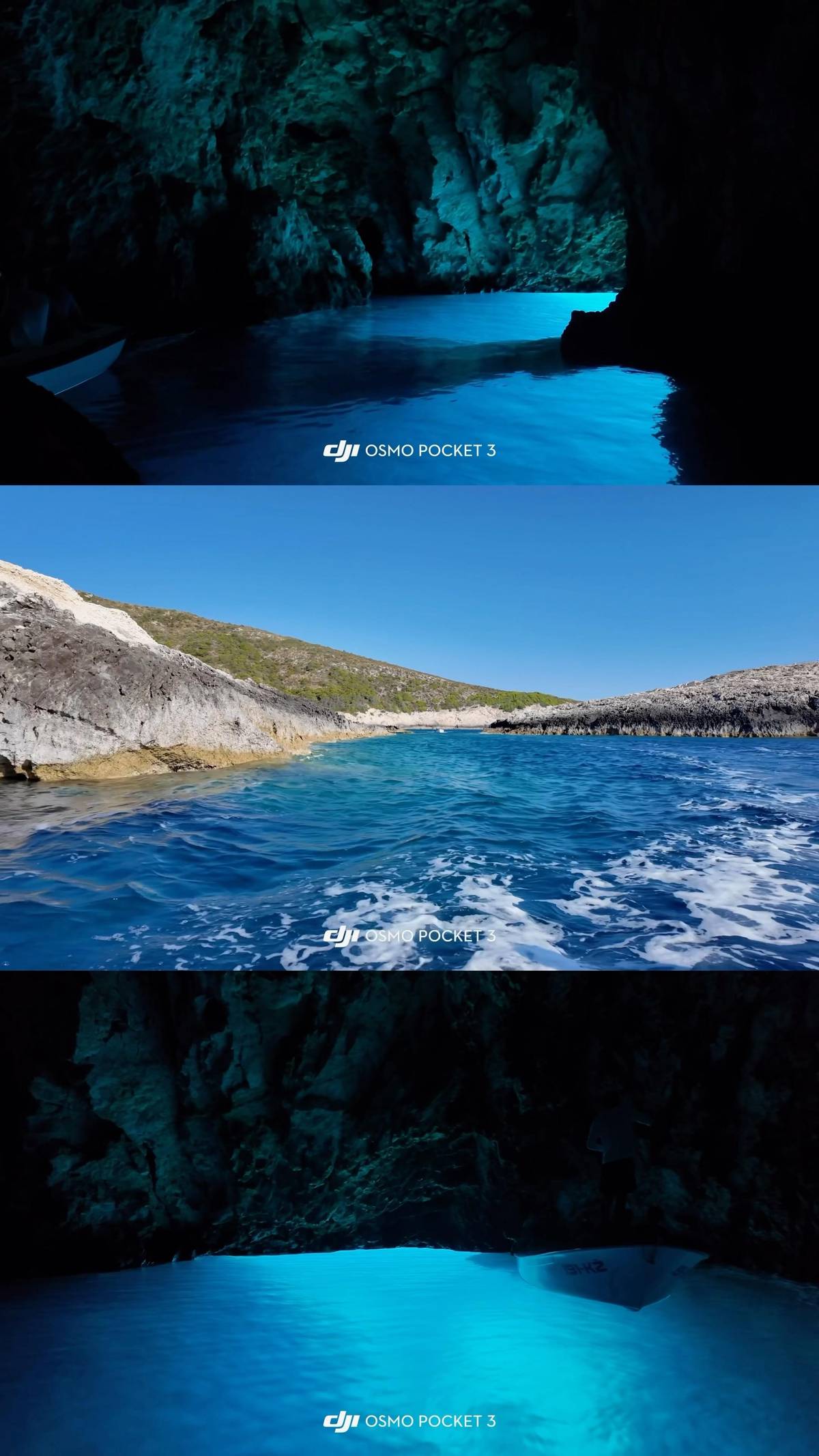
The effect that made the cave famous comes from geometry rather than magic. The visible entrance is small, but under the surface there is a wider opening on the southern side of the cave.16 Sunlight passes through that underwater opening, which lies at a depth of 12 metres, and floods the water inside.3 The floor of the entrance area and of the main cavern is sandy and light yellow, so the light bounces off it and rises through the water.4 The walls stay dark and the sea seems to glow from beneath your boat.
The sun has to be in the right place for this to work. In the morning the sun shines from the east onto the sandy bottom through the submerged entrance, and the reflected light lights up the whole interior.17 That is why the official advice on timing points to the middle of the day. The Komiža Tourist Board puts the best time between 10 am and 2 pm, depending on the time of year.18 The Split Tourist Board gives a slightly earlier window, between 9 and 13 o'clock.19
Expect a deep electric blue in the water, with a silvery shimmer on anything submerged, and a dim vault overhead. On a grey day, or when the boats arrive late in the afternoon, the colour is weaker, though the cave is still an impressive space. If you have the choice, a tour that reaches Biševo before the early afternoon gives you the best chance of seeing the glow at full strength. Bring a phone with a decent low-light mode and switch the flash off: it only lights up the nearest rock.
Ways to get there
Our pickFrom Hvar harbour
 Green Cave too
 From the mainland
Trg Republike, Split
Decision helper
Match your wish to the honest answer
Swimming, bathing and diving are forbidden in the Blue Cave.5
The Komiža Tourist Board's window is 10 am to 2 pm.18
The day from Hvar harbour lasts 7.5 hours with up to 12 people.
The way in is only 1.5 m high, so you duck through.21
The Hvar speedboat is not suitable for children under 2.
In the morning, when the sun shines from the east onto the sandy bottom through the submerged entrance to the Blue Cave, a large quantity of light reflects from the sand
The Blue Cave is smaller than most first-time visitors imagine. The Komiža Tourist Board describes it as 10 to 12 m wide and 24 m long.20 The Split Tourist Board gives the same length, a depth of 10 to 12 metres and a height of up to 15 metres.22 In practice that means a single chamber that a small boat crosses in a slow loop, turning in the light before it glides out again.
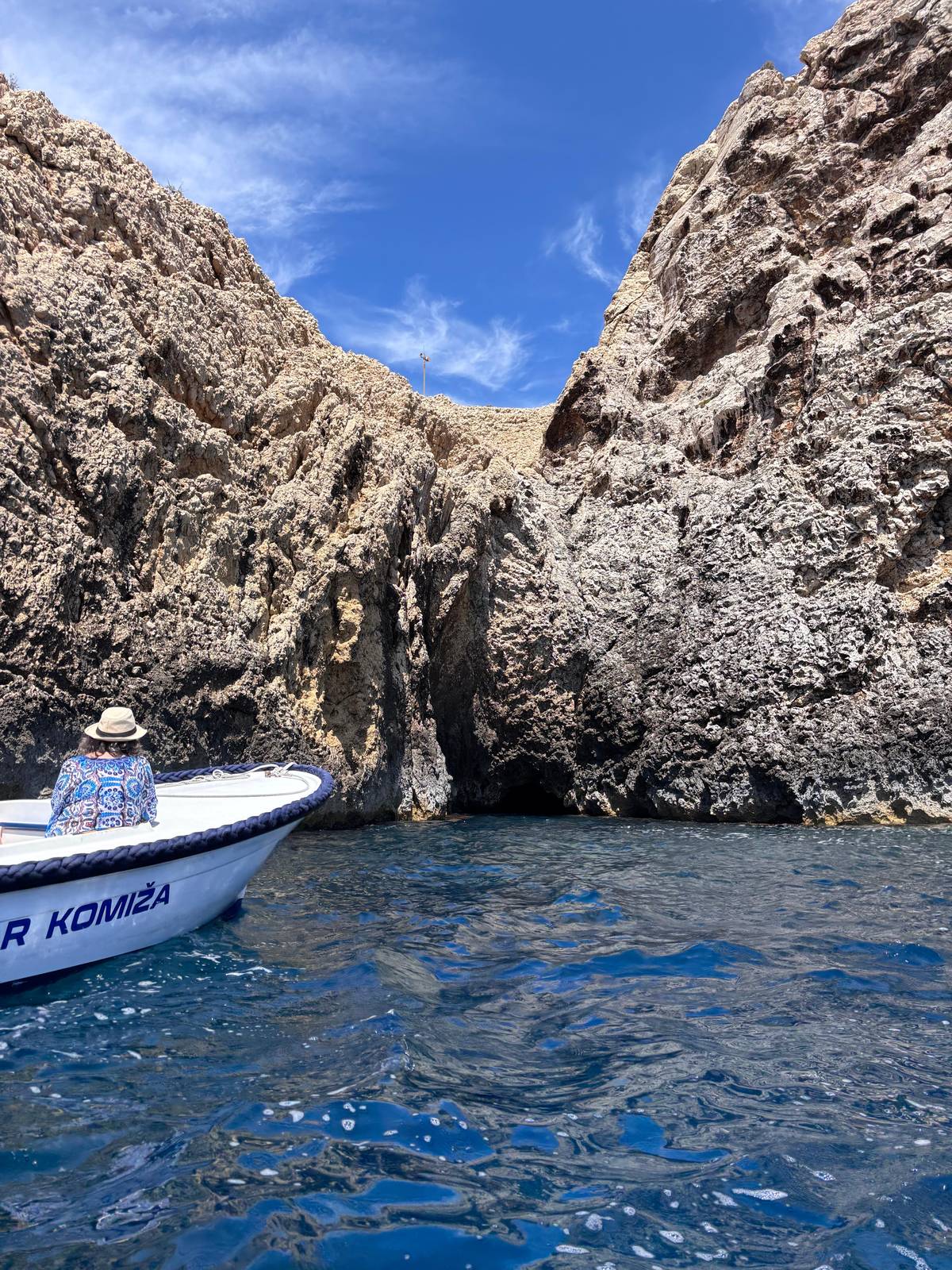
The way in is the tight part. Boats enter through a narrow entrance 1.5 m high and 2.4 m wide, according to the Komiža Tourist Board.21 The Split Tourist Board measures it at 1.5 metres high and 2.5 metres wide.22 Either way, everyone on board ducks as the boatman pulls the boat through, and anyone tall will be glad to keep their head down. Besides this way in and the underwater opening, the cave has two more entrances, one from the sea and one from land.26
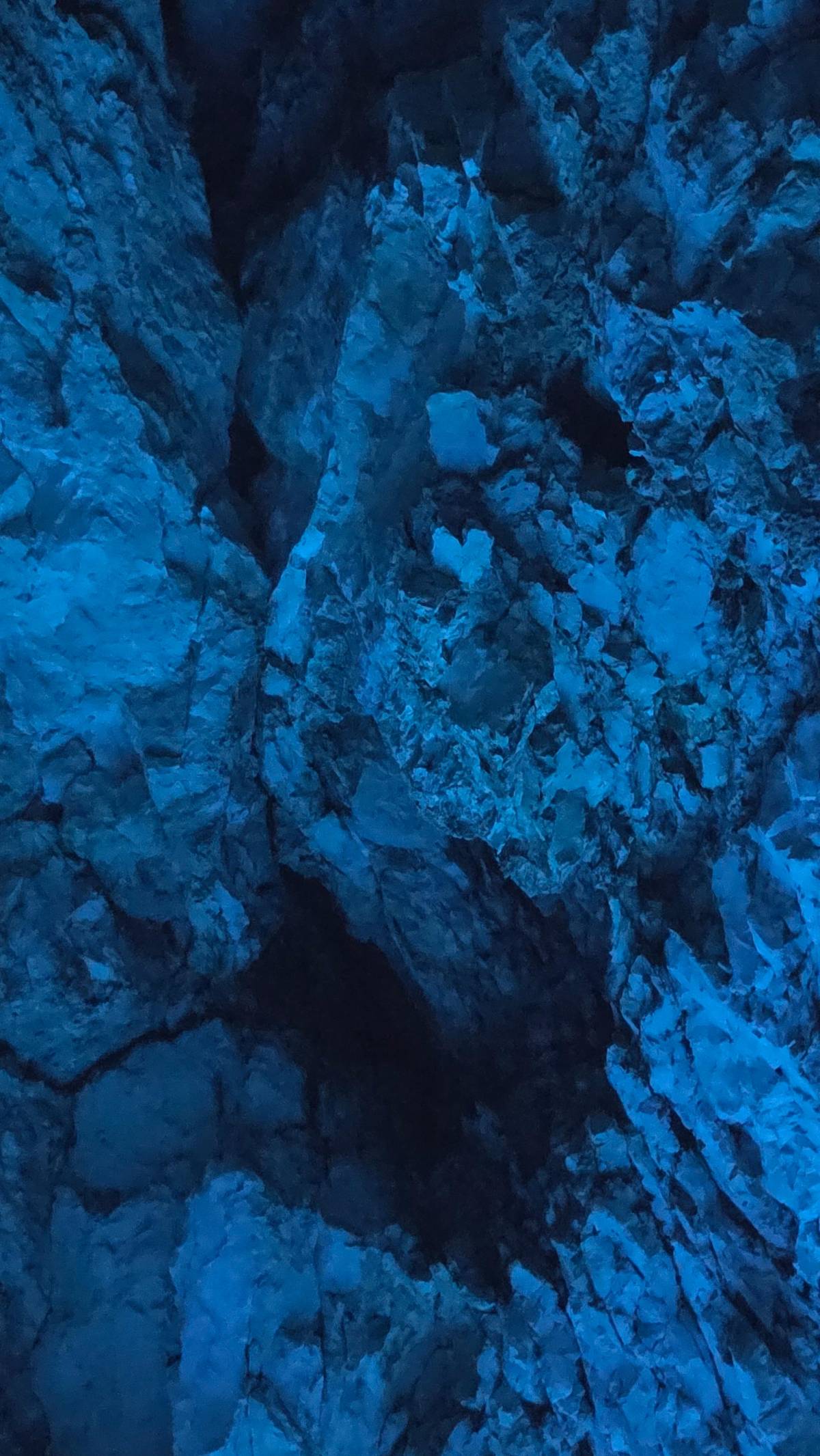
Inside, the cave is a living place as well as a sight. A survey in 2019 found 119 marine species in the Blue Cave, five of them strictly protected by law.15 A living overgrowth covers the rocks, which is why the walls look darker than the sand below.17 Treat it as a small nature reserve that you are allowed to float through for a few minutes, rather than as a show cave with lights and paths.
Map
The speedboat route from Hvar town past the Pakleni islands to the caves and coves of Vis, a closer look at Komiža and Biševo, and where Split, the ferries and Dubrovnik sit on the coast.
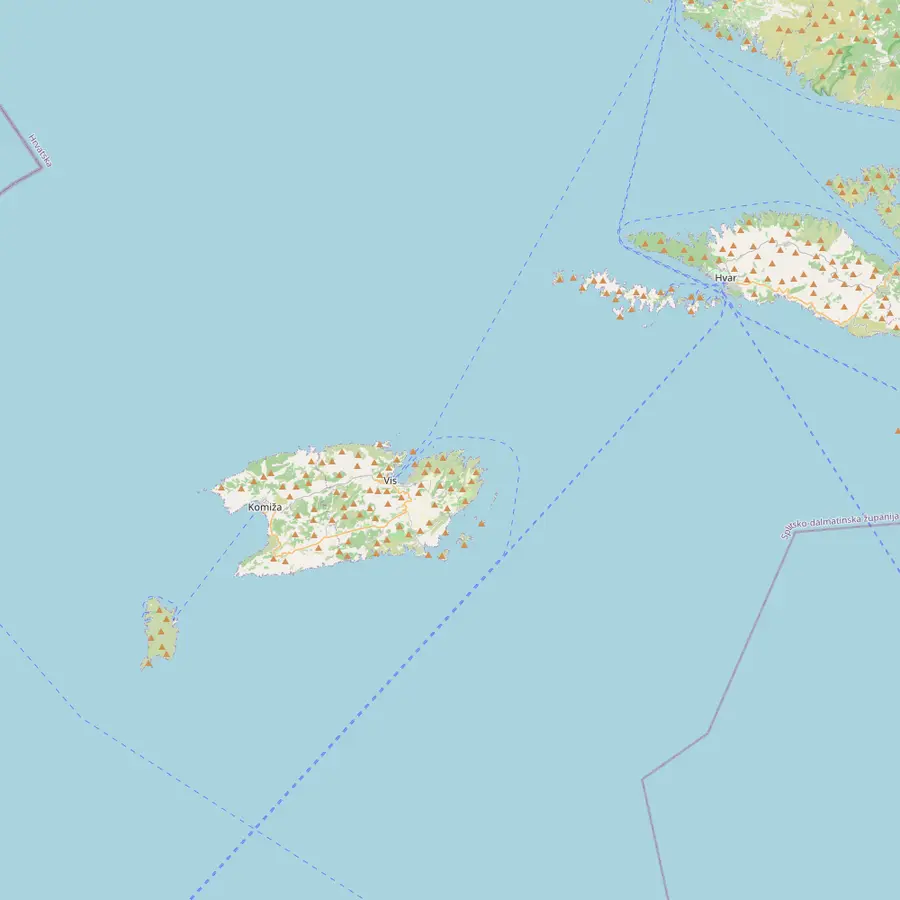 1Hvar Town2Palmižana3Green Cave4Budikovac5Stiniva6Blue Cave7Komiža8Vis town
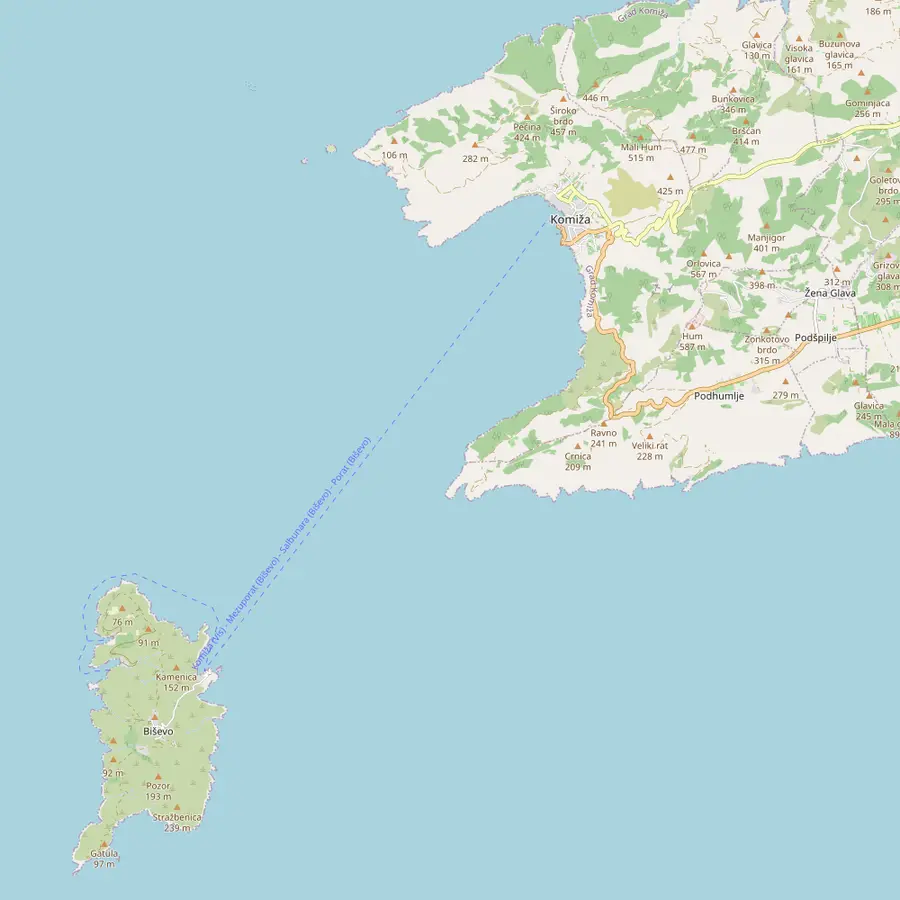 6Blue Cave7Komiža9Pritišćina
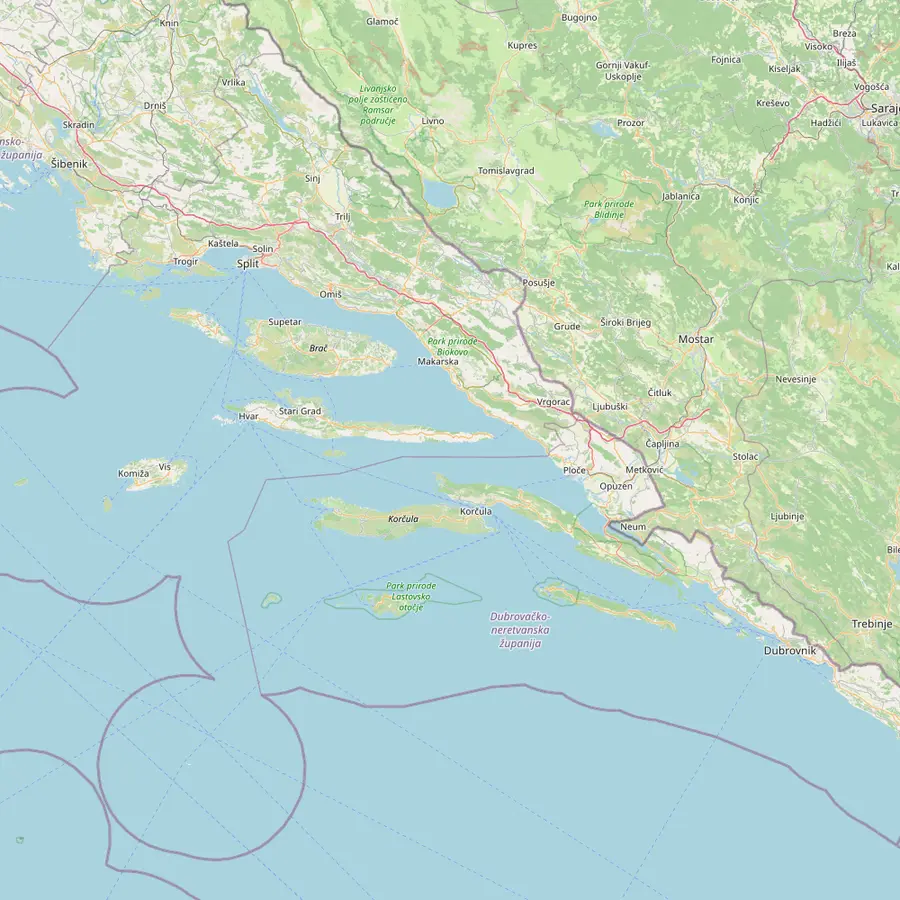 10Split11Split Airport12Stari Grad1Hvar Town8Vis town6Blue Cave13Dubrovnik14Koločep
The Kabina Boats office on the harbour, where the Vis and Blue Cave speedboat starts.
In Google Maps ↗ACI Marina Palmižana, about 2.5 nautical miles from Hvar town.27
In Google Maps ↗On the islet of Ravnik, a protected monument of nature since 1967.23
In Google Maps ↗The Blue Lagoon swim stop named on the Hvar listing.
In Google Maps ↗A pebble bay ringed by limestone cliffs, reached by sea or steep paths.28
In Google Maps ↗In Balun cove on Biševo, 4.5 nautical miles (8.3 km) off Komiža.1
In Google Maps ↗13 km from Vis town, a 15-minute bus ride.29
In Google Maps ↗Linked to Split by a ferry that runs all year.30
In Google Maps ↗The other swim stop the Hvar listing may use instead of Budikovac.
In Google Maps ↗Catamaran line 9602 calls at Milna, Hvar town and Vis.31
In Google Maps ↗A private catamaran reaches Stari Grad in one hour.32
In Google Maps ↗Hvar's main car ferry terminal, 20 minutes by road from Hvar town.33
In Google Maps ↗Koločep lies 25 minutes by ferry from Gruž port.34
In Google Maps ↗Its Blue Cave is a sea grotto reached by boat.35
In Google Maps ↗Checklist
Video
No YouTube code runs on this page until you press play.
People on Vis and Biševo knew about the cave long before anyone wrote about it. Local fishermen used it, and the wider public only heard of it in 1884, through the Austrian explorer Eugen von Ransonnet.11 The official Biševo site calls him a Viennese painter and says his discovery marked the beginning of tourism in Dalmatia.12 He compared the silvery-blue light with the famous Blue Grotto on Capri, and the name stuck.
Ransonnet did more than describe it. At his suggestion, the present entrance at sea level was blasted through, so that small boats could get in.13 The Split Tourist Board puts it the same way: the smaller entrance was artificially widened and deepened so a boat could pass.16 Every visitor since has entered through that man-made gap, which is why the doorway is so neat and so low compared with the rough natural rock around it.
The cave became a protected geomorphological monument of nature in 1951.14 Today the island's nature is guarded by rangers of the public institution Sea and Karst, who may check visitors and their boats.36 The name you will hear locally is Modra špilja. Some guides and maps call it the Blue Grotto of Biševo, a nod to the Capri comparison, but both names mean the same small cave in Balun cove.
You cannot simply paddle in. To protect the cave and for safety reasons, it can only be visited accompanied by the concession holder.7 Organised visits leave from the nearby Mezoporat cove, and from there the visit takes about 40 minutes.6 It is not possible to visit the Blue Cave without a ticket.37 Your tour boat therefore stops outside, you buy a ticket, and you switch to one of the cave's own small boats for the short ride in.
Swimming in the Blue Cave is a common hope and a firm no. Inside the protected cave, bathing, swimming and diving are forbidden, as are fishing, littering and lighting fires.5 The rangers can fine people on the spot under the nature protection law.36 Your swim comes later in the day: the boat from Hvar on this site carries snorkeling gear and stops at coves such as Stiniva and Budikovac, where you can get into the water.
Tickets are sold at the Komiža Nautical Centre, and many agencies across Dalmatia sell organised visits.38 On a tour from Hvar the ticket is usually extra. The listing on this site leaves Blue Cave entry out of its price, at 18 euros in the low season and 24 euros in the high season, payable on site in cash or by card. Our page on tickets, seasons and the best light goes through the official price list in detail.
The Blue Cave is not Biševo's only famous one. The island has a second cave on its southern coast, the Monk Seal Cave, with an entrance 27 metres high and 14 metres wide and an interior 160 metres long, the longest semi-submerged cave on the eastern Adriatic coast.39 You will not go inside, though: entry by boat is strictly prohibited to protect its fragile life and because of the risk of rockfalls.25
The island also has a long human story for such a small place. Benedictine monks from the Tremiti islands founded a monastery on Biševo in 1050.10 The geology is just as dramatic: the official site explains that the cave probably formed by selective erosion as the island rose and the sea climbed after the last Ice Age.40 Massive waves driven by strong southern winds carved the hole out of softer rock.41 That same southern swell is what closes the cave on rough days.
Crowds are the other reality. The Komiža Tourist Board counts about 50 000 visitors a year at the cave.42 In high summer that means a line of tour boats waiting off Mezoporat while the small cave boats shuttle in and out. A good crew will plan around the queue, perhaps swimming elsewhere and coming back, and you should expect some waiting in July and August. The few minutes in the light are short, so be ready with your camera before you reach the entrance.
Into the blue
7.5 hours, up to 12 guests, two caves and swims; cancel free up to 24 hours before.
On Biševo, near Vis. It lies in Balun cove on Biševo, 4.5 nautical miles (8.3 km) off Komiža.1
No. Biševo is 5 km south-west of Vis and belongs to the Town of Komiža; boats from Hvar cross to it.2
No. Bathing, swimming and diving are forbidden inside the protected cave.5
About 40 minutes from Mezoporat. That is the official figure for the organised visit leaving Mezoporat cove.6
Light from below. Sunlight enters an underwater opening 12 metres down and reflects off the bright sand.3
Around the middle of the day. The Komiža Tourist Board says between 10 am and 2 pm, depending on the season.18
Local fishermen first. Eugen von Ransonnet made it known to the wider public in 1884.11
Yes. It has been a geomorphological monument of nature since 1951.14
Sources
Keep reading